Per resolution, per seat or per credit: how to compare AI agent pricing before you sign
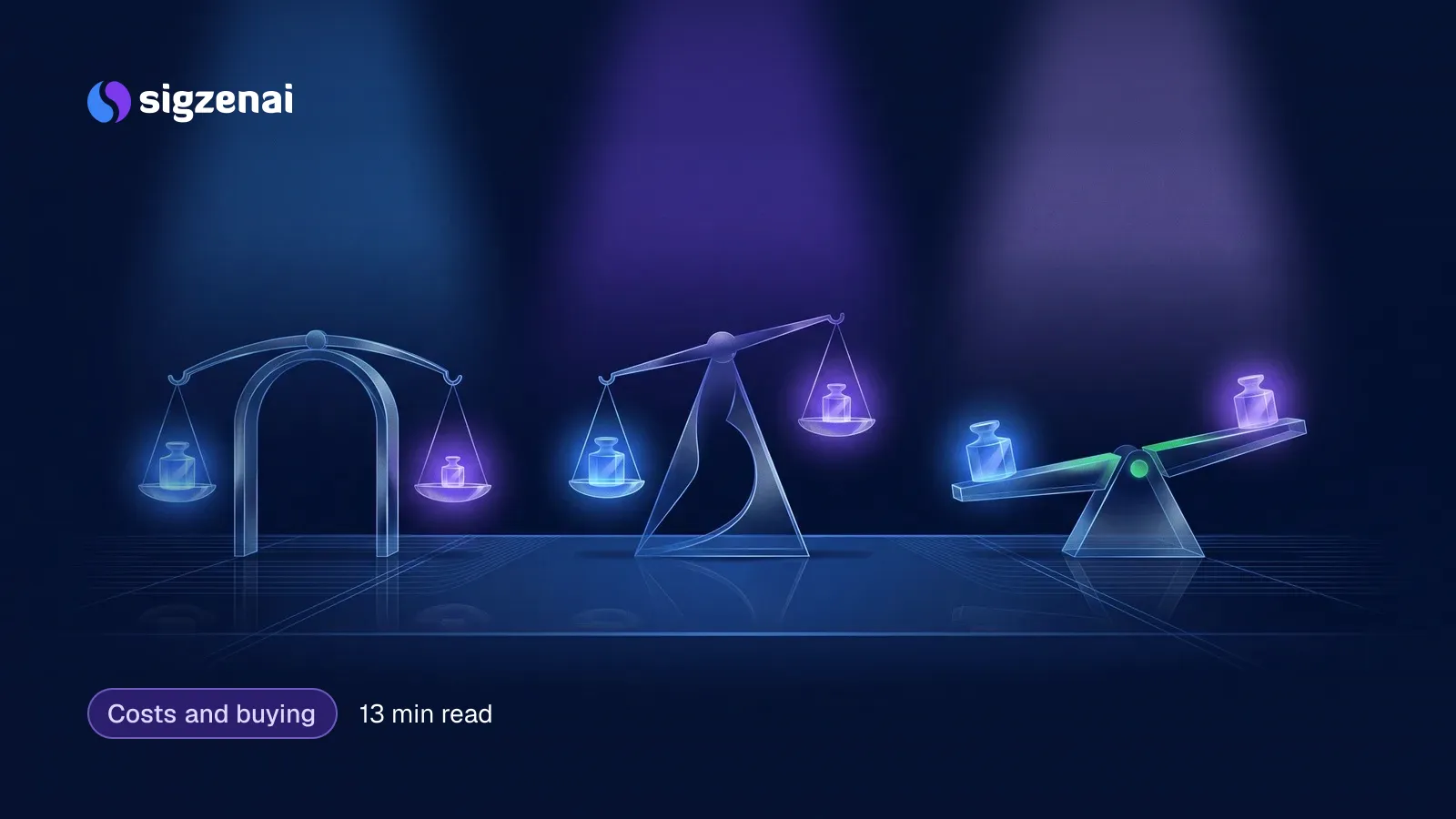
Outcome, seat and credit pricing can't be compared on the quote. Convert each to cost per resolved case at your volumes, with people's exception time included.
The short answer
Convert every AI agent quote to one number: total monthly cost per resolved case at your own volumes. Include the vendor fee, your people's exception time, integration and oversight. Per-resolution pricing looks safest but depends on how the vendor defines a resolution. Seat and credit pricing suit predictable volume. Compare at two resolution rates before you sign.
Key takeaways
- Seat, credit and per-resolution quotes cannot be compared as written; convert each to total cost per resolved case at your volumes.
- Total cost includes the vendor fee plus your people's time on exceptions, integration and oversight, which no quote shows.
- HubSpot moved its Customer Agent from $1.00 per conversation to $0.50 per resolved conversation from 14 April 2026, an example of how fast agent prices change.
- Per-resolution pricing is only as fair as the definition of a resolution, so get that definition, the reopen window and the audit right in writing.
- In KPMG's survey of 204 US leaders at $1bn+ firms (28 April to 25 May 2026), 26% had full real-time visibility of their AI operating costs.
- Run the comparison at a pessimistic and an optimistic resolution rate, because the cheapest model at one rate is often the dearest at the other.
In this article
The short answer: one number per quote
Compare AI agent quotes on total monthly cost per resolved case at your volumes, and on nothing else. A seat price, a credit bundle and a per-resolution fee each measure a different thing. Put side by side as written, they make the vendor with the most favourable unit look cheapest, which is usually the point of the unit.
Cost per resolved case has two halves. The vendor half is what you pay the platform. The people half is what your team spends on the cases the agent cannot finish, plus the time to integrate and oversee it. Quotes show only the first half. The second half is often larger, and it moves in the opposite direction when the agent resolves fewer cases.
Few buyers can see these costs today. In KPMG's quarterly survey of 204 US leaders at companies with $1bn or more in revenue (28 April to 25 May 2026), 53% said they were deploying AI agents.1 Only 26% said they had full real-time visibility of their AI operating costs.1 Our note on that survey covers the gap in more detail. This post gives you a worksheet to close it before you sign.
What are the three pricing models in 2026?
Agent vendors now price in three ways: per seat, per credit or unit of consumption, and per outcome such as a resolved case. Many quotes mix two of them, for example a platform fee plus credits, or a seat licence with an outcome-priced add-on.
Per seat
Seat pricing charges a fixed monthly fee per user, sometimes per human agent whose work the AI supports. It is predictable and easy to budget. It also has nothing to do with how much work the AI does, so its cost per resolved case falls as volume rises and rises as volume falls.
Per credit or consumption
Credit pricing sells a bundle of units that the agent consumes per conversation, action or token, with overage above the bundle. It tracks usage closely. The risk is that you pay for attempts, not results: a conversation the agent fails to resolve uses credits all the same, and then your team handles it too.
Per resolution or outcome
Outcome pricing charges only when the agent completes a defined task. HubSpot's change is a clear recent example. From 14 April 2026, its Customer Agent costs $0.50 per resolved conversation, down from $1.00 per conversation under the previous model.2 Its Prospecting Agent costs $1.00 per lead recommended for outreach.2 HubSpot bills these through its credits, at 50 credits per resolution.2
Our view: outcome pricing moves the right risk to the vendor, but only the risk it names. The vendor carries the cost of failed conversations on its own invoice. You still carry the cost of your people handling them.
What each model bills, and what stays with you
Per seat
- Bills: users, whatever the agent does
- Stays with you: volume risk
- Watch: minimum seats, annual terms
Per credit
- Bills: every attempt, solved or not
- Stays with you: failed attempts, twice
- Watch: overage, credit expiry
Per resolution
- Bills: cases the vendor counts as done
- Stays with you: the definition
- Watch: reopen window, audit right
Why are buyers moving towards outcome pricing?
Buyers want to pay for results because results have been hard to prove. In G2's 2026 Buyer Behavior Report of more than 1,000 software buyers (published July 2026; data period and region not stated), preference for outcome-based pricing rose from 11% in 2025 to 23% in 2026.3 G2 runs a software review marketplace.
Finance is now in the room for these decisions. In the same report (period not stated), finance involvement in software purchases rose from 31% to 46% in a year.3 Our note on finance in software deals covers what a CFO will ask. A per-resolution quote is easier to defend in that meeting, because it reads like a unit cost.
Measured value is still the exception. In McKinsey's survey of 1,719 respondents in 97 countries (4 May to 8 June 2026), 37% said AI had contributed positively to their organisation's EBIT.4 Gartner's analysis of customer-service AI use cases, reported by CX Dive in August 2026, sorts them into use cases that returned value, lost money, broke even or had no clear result.5 Outcome pricing is partly a response to that doubt: the vendor is asked to share it.
AI agents and cost, 2026
Agents are spreading faster than cost control
What counts as a resolution?
A resolution is whatever the contract says it is, so the definition is the price. HubSpot's announcement says customers pay only when the agent completes the task it was assigned: a resolved conversation for its Customer Agent, and a prospect qualified and handed to the sales team for its Prospecting Agent.2 The announcement does not define "resolved" further. Every vendor that prices this way will have its own test, and the details decide your bill.
Ask five questions about any per-resolution quote. Who decides that a case is resolved: the customer, the agent or a rule? What is the reopen window, and is a case that comes back within it refunded? Is a handover to a person ever billed as a resolution? Are abandoned conversations, where the customer simply leaves, counted as resolved? Can you audit a sample of billed resolutions each month?
Our view: a resolution should mean the customer did not need a person for the same issue within a set window, measured by your systems, not the vendor's. Anything looser turns silence into revenue. If a vendor will not give an audit right, treat the quote as a credit price with a friendlier name.
Check the definition per channel as well. A resolution in web chat, email and messaging may be counted differently, and some vendors price voice separately. If most of your volume arrives by email, a definition written for chat can bill cases that a person later reopens by reply.

The worksheet: cost per resolved case at your volumes
The worksheet turns every quote into one comparable number in five steps. You need three inputs from your own systems: monthly volume, a realistic resolution rate and the minutes a person spends on a case the agent cannot finish.
Convert any quote in five steps
- Set volumes
Monthly conversations or tasks, from three months of system data.
- Set two resolution rates
A pessimistic and an optimistic share the agent finishes alone.
- Price the vendor half
Seats, credits with overage, or fee per resolution, at each rate.
- Price the people half
Unresolved cases times handling minutes times loaded cost, plus oversight.
- Divide
Total monthly cost divided by resolved cases, at both rates.
Here is the worksheet run on three invented quotes for Tailspin, a fictional retailer with 5,000 support conversations a month. A person spends about 8 minutes on each conversation the agent hands over, at a loaded cost of about USD 30 an hour, so each handover costs about USD 4. Oversight adds about USD 1,000 a month whatever the model. All of these are assumptions.
| Quote | Vendor fee a month | At 40 in 100 resolved | At 70 in 100 resolved |
|---|---|---|---|
| A: per resolution, USD 1 each | USD 2,000 or 3,500 | USD 15,000 total, USD 7.50 a case | USD 10,500 total, USD 3.00 a case |
| B: seats, flat USD 2,500 | USD 2,500 | USD 15,500 total, USD 7.75 a case | USD 9,500 total, USD 2.71 a case |
| C: credits, USD 2,000 for 4,000 chats, then USD 0.60 each | USD 2,600 | USD 15,600 total, USD 7.80 a case | USD 9,600 total, USD 2.74 a case |
Illustrative. Tailspin and all quotes are fictional; totals are vendor fee plus handover cost (unresolved conversations × USD 4) plus USD 1,000 oversight, divided by resolved conversations.
Two things stand out. First, the people half dominates. At the pessimistic rate, handovers cost USD 12,000 a month, several times any vendor fee. Second, the ranking flips. Quote A is cheapest per case at the low rate and dearest at the high one, because its fee grows with every resolution.
Our view: the resolution rate matters far more than the pricing model. A vendor whose agent resolves more of your cases at a higher unit price usually beats a cheaper one that hands more work back. Ask each vendor for a pilot on your own data before you compare prices, and our guide to pilot length and budget sets out how long that pilot should run.
How to model a credit price
A credit price needs one extra step: find out how many credits a typical case burns. Ask the vendor for the credit cost of each action the agent takes, such as a reply, a lookup in your CRM or a handover, and for the average number of actions per conversation in a comparable deployment. Then test it in the pilot, because long or messy conversations burn more.
Consumption budgets are becoming normal inside companies. In G2's report (period not stated), 80% of organisations said they give developers or technical teams a dedicated token or LLM usage budget.3 Treat an agent's credits the same way: a monthly budget, an alert at three quarters of it and a named person who decides what happens when it runs out.
Spread one-off costs over the contract term as well. Integration work, data clean-up and set-up fees belong in the monthly total, divided by the months you expect to run the agent. A cheap monthly fee with a large set-up charge can lose to a dearer fee with none over a one-year term.
Which costs does each quote leave out?
Every model leaves out your people's time, and each one hides a further cost of its own. Read the contract for the items below before the worksheet is final.
Seat contracts often come with annual commitments and minimum seat counts. Credit contracts carry overage rates, expiry of unused credits and price changes per action type. Outcome contracts may carry a platform fee, a minimum monthly charge or a different price per channel. All three may charge separately for integrations, premium connectors or extra environments.
Prices also move during the term. HubSpot's own change from a per-conversation to a per-resolution price shows how quickly a model can shift.2 Buyers are responding with shorter commitments: in G2's report (period not stated), 70% said the pace of AI innovation was pushing them towards shorter contract terms.3
The internal costs repeat every month. Someone owns the exception queue, reviews a sample of the agent's work, updates prompts and rules, and watches cost per task. Our breakdown of monthly running costs lists them in full, and our guide to designing the exception queue covers the largest one.
Which model fits which process?
Match the model to how predictable your volume and resolution rate are. Seat and credit pricing reward a process you already understand. Outcome pricing protects you where you do not yet know how many cases the agent will finish.
Choosing a pricing model
Volume predictability →
Resolution rate certainty →
Our view: for a first agent, a short per-resolution contract with an audit right is usually the cheapest way to learn your real resolution rate. Once you know it, re-run the worksheet. Teams with steady volume and a proven rate often save by moving to seats or committed credits at renewal.
Scale changes the maths too. In McKinsey's 2026 survey (May to June 2026), 40% of respondents at organisations with $1 billion or more in revenue reported scaling AI agents, against 22% below that size.6 Larger buyers can commit volume and negotiate. Smaller ones usually cannot, which makes outcome pricing more attractive at the start.
What to put in the contract
Put the definitions and the exits in writing, because the worksheet is only as good as the terms behind it. These are the clauses we would ask for on any agent contract.
- A written definition of a resolution, with the reopen window and who decides.
- A monthly audit right over a sample of billed resolutions or credit use.
- Usage alerts and a hard cap on overage or monthly charges.
- Notice before any price or unit change, and the right to leave if one applies.
- Export of conversation logs, prompts and configuration on exit.
- A term no longer than you need to prove the resolution rate.
Run the worksheet again before signing with the vendor's final terms, not the proposal. Our scoring model for a first process should come first, because no pricing model rescues a process with the wrong volume or too many exceptions.
How we price our own automation work
At Sigzen AI we publish fixed prices for building and running agents, not per-resolution fees, and we say so here so you can weigh our view. On our pricing page, the automation sprint is from $10,000 (₹4L) over 4–8 weeks for one workflow live in production, with acceptance criteria agreed before the build and hours saved signed off at the end. Managed AI-ops is from $2,000 (₹1L) a month for monitoring, cost-per-task tracking and prompt and model upgrades.
The platform fees in this post are separate. They go to whichever vendor runs the agent, on whichever model you choose. Our AI automation page describes how we build on the CRM, helpdesk or ERP you already run, which keeps the vendor choice yours.
Whichever route you take, the rule stays the same. Agree what a resolution means, measure it on your own systems, and compare every option on cost per resolved case at two resolution rates. A quote that cannot be put into that worksheet is not ready to sign.
Sources
- KPMG, AI Quarterly Pulse Q2 2026: 204 US leaders at $1bn+ firms, 28 Apr–25 May 2026 (Jun 2026)
- HubSpot, Customer Agent and Prospecting Agent move to outcome-based pricing from 14 Apr 2026: company announcement (Apr 2026)
- G2, Buyer Behavior Report (Jul 2026); data period and region not stated
- McKinsey, The State of AI 2026: n=1,719, 97 countries, 4 May–8 Jun 2026 (Aug 2026)
- CX Dive, only one quarter of AI customer service use cases produce ROI, reporting a Gartner analysis (Aug 2026)
- McKinsey, The State of AI 2026: organisations with $1 billion or more in revenue vs below $1 billion (Aug 2026)