Industrial buyers ask AI for specs and suppliers. What should a manufacturer publish, and where?
AI answers on industrial queries mention big brands but cite directories, distributors and spec pages. What a manufacturer should publish, and on which sites.
The short answer
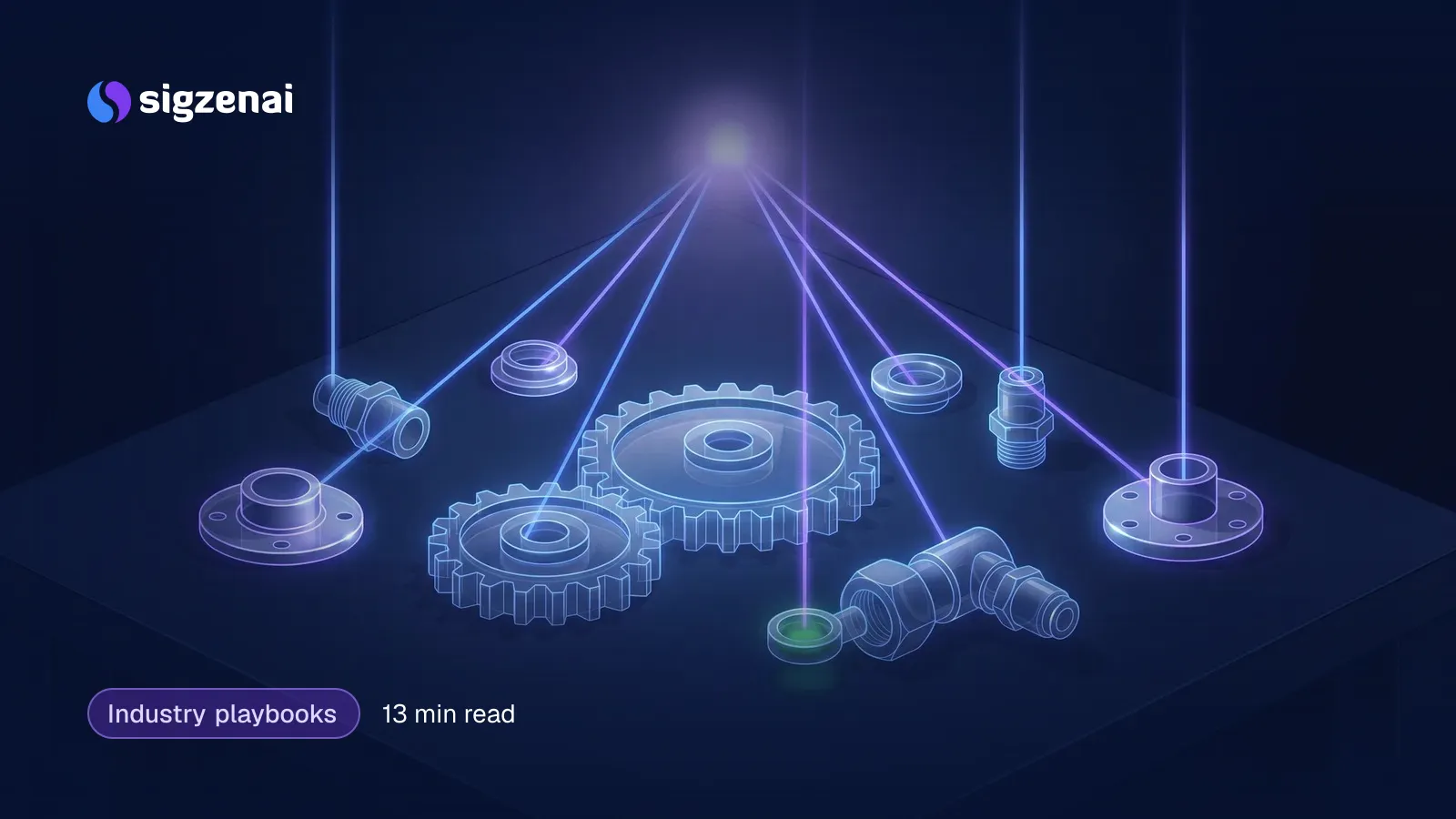
Publish specifications, part numbers, certifications, lead times and where-to-buy details as plain HTML on your own site, then make sure distributors, directories and marketplaces carry the same facts. AI answers name long-established brands but cite a mix of spec pages and third-party listings, so a manufacturer needs both its own pages and consistent listings elsewhere.
Key takeaways
- In Semrush's clickstream data on US sessions to manufacturing sites, January–July 2026, AI search tools sent 0.48% of sessions, so referral traffic understates how often buyers meet a brand in an AI answer.
- In the same study, Google showed AI Overviews on 57% of tracked manufacturing search volume in July 2026, up from 38% in January.
- Among the 15 most-mentioned and 15 most-cited domains in Semrush's manufacturing data, only two appeared on both lists, so being named and being cited are separate goals.
- Profound's analysis of 11.84 billion citations (16 April–16 July 2026) found Gemini cited company-owned sites 69% of the time and ChatGPT 47%.
- Specifications locked in PDFs or images are hard for engines to quote; the same facts as HTML tables on a part or product page are easy to cite.
- The buyers AI sends still arrive as emails, RFQs and invoices, so the operations side deserves the same attention as the content side.
In this article
Why AI answers matter before the traffic shows up
Industrial buyers now meet suppliers inside AI answers long before they visit a website, and analytics barely registers it. That is the main reason a manufacturer should plan for AI search now, even though AI referrals look small.
The traffic numbers are small. Semrush, which sells SEO and AI visibility software, analysed sessions to US manufacturing sites from January to July 2026. AI search tools and assistants sent 0.48% of all sessions, while direct visits and organic search together sent nearly 80%.1
Semrush points to the reason the share understates AI's role. In its research, B2B buyers said they often follow an AI conversation with a Google search or a direct visit to a brand the answer mentioned.1 Those visits are logged as direct or organic, not as AI.
Our view: judge a manufacturer's AI visibility by what the answers say, not by the referral line in analytics. An engineer who reads your company name in a ChatGPT shortlist and later types your domain into a browser is an AI-influenced buyer. Your reports will never label them that way. Our note on the Semrush sessions data covers the traffic side in more detail; this post is about what to publish.
How often does Google answer manufacturing searches with AI?
Often, and more often each month. Across 458 manufacturing and industrial keywords, Semrush found AI Overviews on 38% of search volume in January 2026 and 57% in July.1
The growth was not limited to "what is" questions. Semrush saw specific product searches and part-number queries gain an AI Overview over the same months.1 That is the territory where a manufacturer's own pages used to win the click.
For context, a broader benchmark sits lower. Conductor, another vendor in the category, found AI Overviews on 25.11% of 21.9 million US searches across ten industries, in data from September and October 2025.2 The methods differ, since Semrush weights by search volume on a fixed keyword set. Even so, manufacturing queries do not look like a corner that AI answers have skipped.
US manufacturing and AI search, 2026
Small traffic, large exposure
Being named and being cited are two different races
In manufacturing, the brands an AI answer names and the sites it links to are mostly different. Semrush compared the 15 most-mentioned brands with the 15 most-cited domains in its US manufacturing data across ChatGPT, Gemini, AI Mode and AI Overviews. Only two names appeared on both lists.1
The most-mentioned brands were long-established manufacturers with wide product ranges. The most-cited domains were a mix: industry directories, industrial distributors, a B2B marketplace, an engineering reference site, a few manufacturers and a professional body that publishes research.1 The engines also disagreed. The domain ChatGPT cited most often did not appear among the top-cited sources on Google's AI surfaces at all.1
This splits the job in two. A mention depends on reputation, which builds slowly through everything written about you. A citation depends on having the page that answers the question, on your site or somewhere the engine trusts. A mid-sized manufacturer cannot buy a century of brand history, but it can publish the answer.
Mentions and citations reward different work
Being mentioned
- Brand named in the answer text
- Follows reputation and coverage built over years
- Slow to move; measured by share of answers
Being cited
- Your page linked as a source
- Follows having the specific answer, in readable form
- Can move in weeks; measured by cited URLs
Does AI cite your site or someone else's?
It depends on the engine, which is why a manufacturer needs both its own pages and third-party listings. Profound, which sells AI visibility software, analysed 11.84 billion citations across eight engines between 16 April and 16 July 2026. About 57% of citations went to company-owned websites, counting any company's site, not only the brand being asked about.3
The split by engine is wide. Gemini cited company-owned sites 69% of the time and ChatGPT 47%.3 Industries differ too: the median brand-site share was 74% in cybersecurity, while in pharmaceuticals earned media took a median 59%.3 Profound does not report a manufacturing figure, so treat these as a range rather than a forecast for your sector.
Our view: for a manufacturer, Gemini and Google's AI features reward a strong own site, and ChatGPT leans more on distributors, directories and reference sites. Plan for both. A spec page that only lives on your domain will be under-cited in ChatGPT; a listing that only lives on a marketplace leaves Google's surfaces to someone else's page.
What to publish on your own site
Publish the facts an engineer or buyer checks before contacting a supplier, as plain HTML, one product or part per page. Most manufacturers already have this information. It usually sits in PDF datasheets, image-based catalogues or a configurator that a crawler cannot read.
| Page | What it should state | Why an engine can use it |
|---|---|---|
| Product or part page | Part number, dimensions, materials, ratings, tolerances | Answers spec and part-number prompts directly |
| Specification table | The datasheet values as an HTML table, units included | Values can be quoted; a PDF often cannot |
| Certifications and compliance | Standards met, certificate numbers, issuing body, dates | Buyers filter suppliers on these first |
| Ordering facts | Minimum order, typical lead time, regions shipped to | Shortlist prompts ask about supply, not only specs |
| Applications pages | Industries served, typical uses, known limits | Matches "which supplier for this job" prompts |
| Where to buy | Authorised distributors and how to order direct | Links your site to the listings engines cite |
| Company facts | Founding year, plants, capacity, contacts | Gives engines one consistent source for basics |
Illustrative. A starting list; your buyers' questions decide the order.
Two rules apply to every page on that list. Keep the specification in text, never only in an image or a drawing, because the engines read words, not pictures of tables. And date anything that changes, such as lead times or certificate expiry, so that an engine quoting an old page is quoting something visibly old rather than something wrong.
Selection guides earn a special place. A page that explains how to choose between two of your product lines, with the trade-offs stated plainly, answers the comparison prompts buyers type. It also gives an engine a reason to cite you rather than a generic reference site. Semrush's data showed that generic, easily summarised reference content drew citations but few clicks, while specific, original material gave readers a reason to visit.1
Where else your facts need to live
Your facts also need to appear, consistently, on the third-party sites that engines cite for your category. In Semrush's manufacturing data those were directories, distributors, marketplaces and reference sites.1 Which ones matter for your products is something to check, not assume.
- Distributors. Make sure each authorised distributor's listing carries your current part numbers, specs and datasheet links. A distributor's page is often the one an engine quotes for availability.
- Industry directories. Keep one complete, accurate profile on each directory your buyers use, with the same company facts as your own site.
- Marketplaces. If you sell through a B2B marketplace, the listing should match your own catalogue on specs and naming.
- Reference and trade sites. Contribute technical material where engineers already read, such as trade association resources and standards bodies' member pages.
Consistency is the point. When a distributor lists an old rating and your site lists a new one, an engine may quote either, or hedge. Our explainer on review sites and directories sets out how to decide which profiles are worth keeping complete.
How an industrial buyer's AI answer is assembled
- Buyer prompt
- Engine retrieves sources
- Your spec pages
- Distributors and directories
- Shortlist in the answer
- Search, visit or RFQ
Testing US prompts, with a German-language contrast
Test the questions your buyers actually ask, in each country and language you sell in, because each is a separate sample. A manufacturer selling in the US and Germany needs two prompt sets, not one translated list.
The example is invented, but the point behind it is practical. Engines tend to retrieve sources in the language of the question, so German answers draw mostly on German-language pages, and a manufacturer with only English specs may be missing from them. Our measurement spec explains why country and language must be measured separately.
Most of those answers will carry no link at all. Similarweb measured how often answers to US ChatGPT prompts carried a citation: about 1.6% of prompts in June 2025, rising to about 6.8% in May 2026.4 That rate varied by category, from about 23% in travel to under 4% in professional services.4 When most answers name suppliers without linking anyone, the mention is the outcome to track.
Run each prompt more than once, because answers vary between runs. Our audits run each prompt on three separate days across six engines (ChatGPT, Gemini, Perplexity, Claude, Copilot and Google AI). We use official APIs where they are offered and a licensed AI-answer data provider otherwise.
How should a manufacturer measure progress?
Measure the answers first and traffic second. Three numbers tell you more than the AI referral line: how often you are named for your prompt set, which of your URLs are cited, and whether branded search and direct visits move after those change.
Benchmarks for AI referrals are still thin for this sector. Conductor's cross-industry benchmark, first published in November 2025, put AI referrals at 1.08% of visits in traffic data from 1,215 US enterprise customer domains. Its referral data covers May to September 2025, so it is now about a year old.5 Semrush's 0.48% for US manufacturing sites, in data from January to July 2026, is the more current figure.1 Either way, the traffic is too small to steer by on its own.
Add one field you control. Put "How did you first hear about us?" on the RFQ form with "an AI assistant" as an option. It is self-reported and imperfect, but it captures the buyer who saw your name in an answer and came back a week later through a search.
Benchmark against the right rivals. The brands an engine names for your prompts may not be the competitors your sales team worries about; a distributor or a marketplace can take the slot instead. Record every name that appears in your baseline, then pick four or five that recur as your comparison set. Measuring your share of answers against that set each quarter shows whether your pages and listings are working, independent of how fast AI traffic grows.
The operations follow-on: orders, RFQs and invoices
Buyers that AI sends your way still arrive as emails, RFQs and purchase orders, and they leave as invoices. A manufacturer that improves its AI visibility should expect more inbound documents. The operations behind them are often still keyed by hand.
Two processes usually carry the load: order entry from emailed purchase orders, and accounts payable on the supplier side. Both are document queues with steady volume, which makes them candidates for an AI agent working inside the ERP. The controls matter more than the model. Our guide to an invoice agent's ERP controls sets out the approval steps.
E-invoicing mandates add a deadline for manufacturers that trade in Europe. Grant Thornton Netherlands lists mandatory B2B e-invoicing in Belgium from 1 January 2026 and in France from September 2026, with EU cross-border e-invoicing under the VAT in the Digital Age package from 1 July 2030.6 A US manufacturer with European customers or suppliers will meet these formats through its trading partners. Our explainer on e-invoicing and AP agents covers where an agent fits once invoices arrive structured.
E-invoicing mandates a manufacturer trading in Europe will meet
Belgium: mandatory B2B e-invoicing
France: mandatory B2B e-invoicing begins
EU cross-border e-invoicing under VAT in the Digital Age
A disclosure: Sigzen AI is part of Sigzen Technologies, which has implemented and supported ERPNext for a decade, and we build these workflows on our AI automation side. Weigh our view on the operations follow-on with that in mind.
Where to start this quarter
Start with the pages buyers check most and the listings engines cite most. The order below fits a mid-sized manufacturer with a small marketing team and a catalogue in PDFs.
- Build a prompt set. Collect 30 to 50 real buyer questions from RFQs, sales calls and distributor enquiries, per country and language.
- Run a baseline. Record who is named, what each answer states about you and which URLs are cited.
- Convert the top products. Turn the datasheets for your best-selling lines into HTML spec pages, one part per page.
- Fix the listings. Correct your profiles on the distributors, directories and marketplaces the engines cited in the baseline.
- Write two selection guides. Pick the comparisons your sales team explains most often.
- Re-run and compare. Repeat the prompt set after eight to twelve weeks, on the same engines and days of the week.
Our view: the manufacturers that will do well in AI answers are not necessarily the largest. They are the ones whose specs are readable, whose listings agree with each other, and whose sales team's questions became pages. That is unglamorous work, and most competitors have not finished it.
Sources
- Semrush, manufacturing and AI search: top 20 US manufacturing domains, Jan–Jul 2026 (Sep 2026)
- Conductor, 2026 AEO/GEO benchmarks: 21.9M US searches, 15 Sep–12 Oct 2025 (Nov 2025; page updated Jul 2026)
- Profound, where AI citations come from: 11.84B citations, 8 engines, 16 Apr–16 Jul 2026 (Jul 2026)
- Similarweb, AI search stats 2026: ChatGPT answers with a citation, US, Jun 2025–May 2026 (Jul 2026)
- Conductor, 2026 AEO/GEO benchmarks: AI referral traffic, 1,215 US enterprise customer domains, May–Sep 2025 (Nov 2025; page updated Jul 2026)
- Grant Thornton Netherlands, recent e-invoicing developments in Europe: mandate dates by country (Aug 2026)